
Celebrating Tanz der Vampire
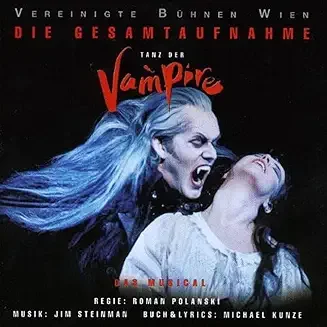
Why Jim Steinman’s Tanz der Vampire — the Vienna original — remains one of the greatest musicals ever staged
In 2002, Broadway killed Jim Steinman’s vampire. The body count was ugly: 56 performances, $12 million lost, and a lead actor who reportedly wouldn’t take direction. The critics were savage. Audiences stayed away. The show closed in humiliation, and the consensus hardened into received wisdom — vampire musicals don’t work.
Except that the show Broadway destroyed was not Jim Steinman’s show. It was a gutted, rewritten, reskinned American approximation of something that had already been running in Vienna for five years, winning awards, selling out houses, and reducing audiences to tears in a language most of them didn’t speak. The real Tanz der Vampire — the one that opened at the Raimund Theater on October 4, 1997 — was, and remains, a staggering achievement: one of the most fully realized, emotionally ferocious, and musically overwhelming theatrical productions of the 20th century.
American audiences, by and large, have never seen it. That is a loss that deserves to be named.
What It Is
Tanz der Vampire is a musical adaptation of Roman Polanski’s 1967 cult horror comedy The Fearless Vampire Killers, with music by Jim Steinman, book and lyrics by Michael Kunze, and directed in its original Vienna production by Polanski himself. That sentence alone should stop you in your tracks. This is a musical conceived by the composer of Bat Out of Hell, written by one of the most respected lyricists in European musical theatre, and staged by one of cinema’s most distinctive visual minds. The wonder is not that it was great. The wonder is that it ever got made at all.
The source material is ideal for Steinman’s sensibility. Polanski’s film is already operatic in structure: doomed love, monstrous seduction, innocence devoured by the night. It has the Wagnerian skeleton that Steinman has always been drawn toward. Add Kunze’s ability to work in German — a language uniquely suited to the combination of philosophical weight and rolling consonantal grandeur that Steinman’s music demands — and the conditions for something extraordinary were in place from the first note.
The Story
Sometime in the late 19th century, Professor Abronsius — a wildly eccentric vampire hunter with an unshakeable belief in his own theories and an almost comical inability to act on them — arrives in a small Jewish village in the Carpathians with his young assistant Alfred. They take lodgings at the inn of one Yoine Chagal, who has a beautiful daughter named Sarah. Sarah is bored, restless, hungry for something she cannot name. She is also being watched.
Graf von Krolock — the vampire lord who lives in the castle above the village — has been watching Sarah for some time. He is not a monster in the conventional sense. He is ancient, melancholy, and utterly without hope. The vampiric existence he inhabits is one of eternal hunger that can never be satisfied, eternal night without warmth, eternal life without meaning. When he sings of what he is, you do not feel revulsion. You feel something closer to vertigo.
Alfred falls helplessly in love with Sarah. Abronsius pursues his academic obsession. Chagal, in a darkly comic subplot, gets himself turned into a vampire almost by accident. Krolock’s son Herbert — flamboyant, gleefully predatory, and very interested in Alfred — adds a layer of anarchic comedy that Steinman delights in. And Sarah, drawn irresistibly toward Krolock’s castle and the freedom she senses it represents, makes her choice.
The show climaxes at the Grand Ball of the Vampires, a delirious set piece in which Abronsius and Alfred, disguised among the undead, realize too late that mirrors don’t lie. The ending does not offer rescue. Sarah has been claimed by the night, and Alfred’s love — genuine, ardent, and completely outmatched by the darkness — is not enough to save her. In the Polanski tradition, the monsters win. The difference is that Steinman and Kunze make you understand why.
The Music: A Steinman Archaeology
One of the stranger pleasures of Tanz der Vampire for Steinman devotees is the detective work. The score is partly built from earlier Steinman compositions, some famous and some deeply obscure, recast in German and recontextualized for the stage. The results are revelatory.
Total Eclipse of the Heart — a song most people associate with 1983 radio, shoulder pads, and windswept drama — becomes Totale Finsternis, and in its new context, performed as a genuine romantic duet between Alfred and Sarah against the backdrop of impending loss, it strips the song back to its original nerve. Steinman wrote it as a vampire song to begin with, as he cheerfully admitted. The stage finally gives it the context it was always asking for.
The melody of Objects in the Rear View Mirror May Appear Closer Than They Are — one of the greatest and most underappreciated songs in the Bat Out of Hell canon — becomes Die Unstillbare Gier, Krolock’s great Act Two aria about the insatiable hunger of his existence. The original song’s nostalgia for lost youth becomes something darker and more cosmic: the hunger of a being who has consumed everything the world has to offer and found it, ultimately, insufficient.
Alongside the repurposed material, Steinman wrote substantial new work for the show, and it is among the best of his career. The opening number Knoblauch (Garlic) is a masterclass in comic horror: a whole village in barely suppressed panic, conducting rituals against a threat they dare not name. Einladung zum Ball (Invitation to the Ball) is Krolock at his most seductive and most terrible, the vampire as aristocrat, as patron, as death dressed in splendor. And the Act One finale is the kind of theatrical set piece that reminds you why live performance exists at all.
Why Vienna, Specifically
Polanski’s direction of the original production brought something that no subsequent version has quite replicated: a visual language rooted in his own cinematic sensibility, applied to the stage without apology. The look of the Vienna production was dark, lush, and specific in the way that Polanski’s films are specific — every image considered, every shadow deliberate. The costumes were designed by Sue Blane, who had created the wardrobe for The Rocky Horror Picture Show, and they carry that same quality of gleeful, committed extravagance.
The original cast was, in every important respect, irreplaceable. Steve Barton, who originated the role of Graf von Krolock, brought to the part a quality that is almost impossible to describe without resorting to superlatives. He was an American performer who had made his name as Raoul in the original London Phantom of the Opera, and he brought to Krolock the same combination of vocal authority and genuine dramatic intelligence that had distinguished that earlier work. His Krolock was not a cartoon villain. He was a man — or something that had once been a man — of immense refinement and bottomless sorrow.
Barton won the 1998 IMAGE Award for Best Actor in a Musical, the European equivalent of the Tony. He died in 2001, at 46, before he could see what Broadway eventually did to his role. The production ran at the Raimund Theater until January 15, 2000 — over two years, and Tanz der Vampire won the IMAGE Award for Best Musical, Best Score, and Best Book in 1998. It was not a cult success or an acquired taste. It was, by every contemporary measure, a triumph.
The Broadway Disaster, Briefly
The American producers who brought the show to Broadway in 2002 made a series of decisions, each individually defensible and collectively catastrophic. They decided the material was too dark for American audiences and made it funnier. They decided the European sensibility was too foreign and Americanized it. They cast Michael Crawford as Krolock, which looked on paper like a coup, and then watched the production collapse around him as directorial chaos, creative disagreements, and a fundamental misunderstanding of what the show was destroyed any possibility of coherence.
Jim Steinman, reportedly appalled by the final product, did not attend opening night. He later described the Broadway version in terms that cannot be reprinted here in their original form, but whose substance was: this is not my show. The show that is dear to me is still running in Europe. The one on Broadway was just a job.
He was right. The show that was running in Europe — in Hamburg, in Stuttgart, across Germany and Austria and beyond — was the show he had made. Broadway got a hollowed-out ghost.
The Original Vienna Cast
The cast of the world premiere production at the Raimund Theater, Vienna, October 4, 1997:
Graf von Krolock: Steve Barton (IMAGE Award, Best Actor in a Musical, 1998)
Sarah Chagal: Cornelia Zenz
Alfred: Aris Sas
Professor Abronsius: Gernot Kranner
Yoine Chagal: James Sbano
Magda: Eva Maria Marold (IMAGE Award, Best Supporting Actress, 1998)
Rebecca Chagal: Anne Welte
Herbert von Krolock: Nik Breidenbach
Koukol: Torsten Flach
Music: Jim Steinman
Book and Lyrics: Michael Kunze
Director: Roman Polanski
Costumes: Sue Blane (The Rocky Horror Picture Show)
Produced by: Vereinigte Bühnen Wien
Where to Find the Recordings
The original Vienna cast recording was released as a double CD in 1998 — a complete recording and a highlights disc — and remains the definitive document of Steinman’s vision for the show. It is sung entirely in German, but the music is constructed in Steinman’s signature way: it carries its emotional meaning in the melody, in the orchestration, in the sheer physical weight of the sound. You do not need to understand every word to understand what is happening.
Both recordings are available on Amazon. The complete double-CD Vienna cast recording — featuring Steve Barton, Cornelia Zenz, and Aris Sas — can be found at:
Tanz der Vampire — Complete Vienna Cast Recording (Amazon US)
A highlights disc is also available for those who want a shorter introduction to the score. For the full experience, however, the complete recording is essential. Act Two in particular — from Totale Finsternis through the Grand Ball finale — is among the most sustained pieces of theatrical music-making of the last thirty years.
The proshot recording of the original 1997 performance also circulates in fan communities and can be found at the Internet Archive. The video quality reflects the technology of the period, but what is captured — Barton in full command of the stage, Polanski’s staging at its most precise, an audience experiencing something completely new — is irreplaceable.
What Was Lost
The standard story of Tanz der Vampire in English-speaking countries is a story of failure: the Broadway disaster, the critical drubbing, the short run. That story is true as far as it goes. What it leaves out is that the show Broadway failed to mount has never stopped running. It has played in Germany, Austria, Hungary, Poland, Estonia, Japan, and beyond. It has accumulated decades of productions, scores of Krolocks, and a devoted international fanbase that grows without any help from the American theatrical establishment.
The Vienna production was not a flawed masterpiece that needed to be fixed for American audiences. It was a complete work of art that did not survive translation — not because the material was too European or too dark or too strange, but because the people entrusted with the translation did not trust it. They took a Steinman show — which is to say, a show built on excess, emotion, and the conviction that being overwrought is not a problem but a virtue — and tried to sand it down into something respectable.
Jim Steinman understood something that Broadway forgot: that the audience for this kind of work is not a niche. It is everyone who has ever felt that the night contains possibilities the day cannot offer, that love and death are not opposites, that the most honest response to the human condition is not irony but volume. That audience is enormous. It just never got to see the real show.
The Raimund Theater, October 1997. A vampire in robes that absorbed light. A girl who wanted to be devoured. A boy who loved her and couldn’t save her. And Jim Steinman’s music — enormous, unashamed, and absolutely certain of itself — filling the room like a storm.
That show exists. Broadway got a ghost. The rest of the world got the real thing.
—