
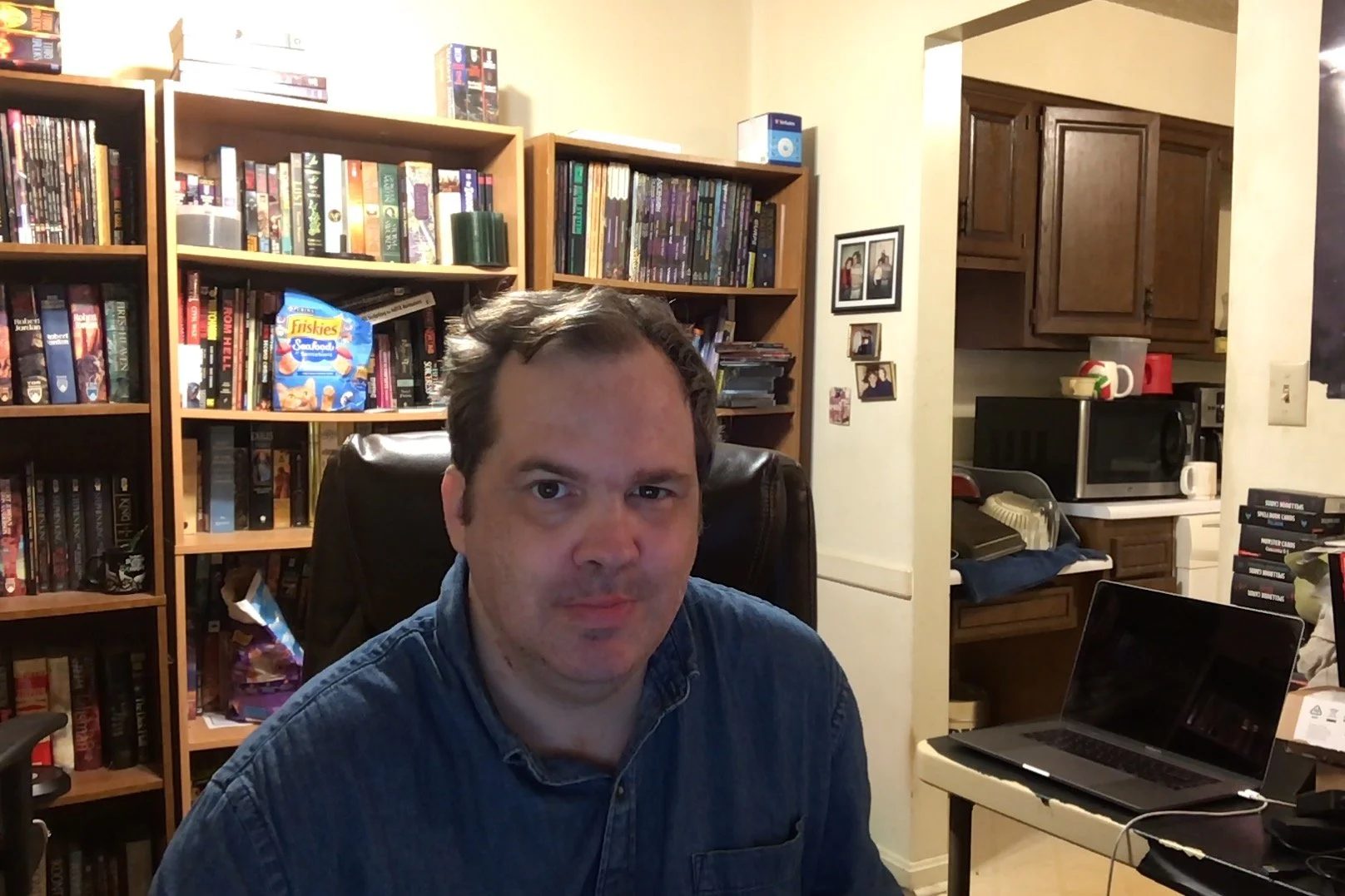
about me
Hello. My name is William Andrew Hainline. I’m a science fiction and fantasy writer who dabbles in the occasional paranormal romantic comedy or buddy comedy. I live in Southern Indiana, along with my kitty, Beau. We sometimes engage in wreck-less writing behavior, such as publishing fantastic fiction and engaging in graphic design, game design, armchair science (and armchair philosophy too), and web design. Come on and sit a spell; I promise I don’t bite. Much.
I was born in Louisville, Kentucky, in the 1970s, which means I arrived in time to watch the tail end of an era when kids were still allowed to be unsupervised and strange. Louisville was a good city for a child with an overactive imagination: big enough to have interesting architecture and the kind of layered history that accumulates into atmosphere, small enough that you could bicycle to the edges of it and find the place where the city gave way to something older and quieter and harder to name. I loved it the way you love a place before you understand it, which is to say completely and without conditions.
Then, in the fifth grade, my mother and stepfather moved the operation across the Ohio River to New Albany, Indiana, and I came along for the ride — not that anyone asked, but that is the nature of being ten years old and the smallest person in any given room. New Albany was a different kind of place: a river town with its own particular character, pressed up against the Indiana flatlands, close enough to Louisville to borrow its skyline but far enough to have developed its own distinct personality. I was a Louisville kid in an Indiana town, which is a minor variety of displacement that is nonetheless real, and which produced, as displacement tends to, a person who spent a lot of time inside his own head constructing alternative versions of the world.
The First Stories
I was ten years old when I understood, with the sudden and absolute certainty that children sometimes have about things that actually matter, that I was a writer.
Not that I wanted to be one — that framing implies a career aspiration, something you circle on a worksheet when a guidance counselor asks what you want to be when you grow up. It wasn't like that. It was more like a recognition. A noticing of something that was already true. I loved making up places — whole geographies, with the specific texture of how the light fell and what the streets were called — and I loved making up the people who lived in them, with their particular histories and their private weirdnesses and the things they wanted that they couldn't quite articulate. The places and the people needed each other. The stories were what happened when they collided.
I wrote my first novel at thirteen. It was clumsy and amateurish in every measurable way — the prose was earnest to the point of self-parody, the plot careened in directions that made sense only from the inside of a thirteen-year-old's head, and the dialogue was the kind of dialogue that has clearly never been spoken aloud by any human being who wasn't reading it off a page. I loved it with the specific, unconditional love you feel for the first version of something before you know enough to see its flaws. More importantly, I knew, the moment it was done — the moment I typed the last sentence and sat back and looked at the stack of pages — that this was what I was going to do with my life. Not because it was good. Because finishing it felt like nothing else I had ever done.
By high school I had graduated to something more ambitious: a novel called They Came from Transylvania High, which was exactly what the title promised and somewhat more besides. Horror-comedy, monster high school, the particular energy of a teenager who has read too much Stephen King and seen too many late-night movies and is trying to synthesize them into something that is recognizably his own. It was, in retrospect, a first attempt at what would become a signature mode — the baroque, maximalist, everything-at-once approach that I have never entirely abandoned and have in recent years stopped trying to. Much later, I would return to that original premise, gut it, rebuild it from the foundations, and release the result as They Came from Transylvania Community College — the same DNA, grown up. You can buy it on Smashwords or Amazon, and I say this without apology, because I am proud of what it became.
IU Southeast, and the Education That Mattered Most
I attended Indiana University Southeast, which sits in New Albany and has the particular quality of a regional campus — intimate in a way that large universities aren't, embedded in its community, full of students who are there because they want to be rather than because the machinery of ambition deposited them there. I studied, depending on what semester you caught me, computer science, English, and fine arts, which is either a wildly unfocused academic career or a very focused one if you understand that what I was actually studying was everything I could get my hands on, and that the formal curriculum was somewhat incidental to that project.
But the education that actually mattered most at IUS — the one that left the deepest mark, that I return to most often when I'm trying to understand something true about being human — was administered by a woman whose name I am going to keep to myself, because some things are private even in a public accounting of a life.
She was the most beautiful person I had ever seen, and she was silly and ditzy and fun in the specific way that people are when they're intelligent enough to afford to be — which is to say that the silliness was real but it was not the whole truth of her, and the whole truth of her included a razor-sharp mind that she deployed with devastating effect on the debate team, where she was, by any objective measure, dynamite. I watched her dismantle arguments with the cheerful efficiency of someone defusing a bomb while humming to herself, and I thought: yes, this is the person. This is the one.
She broke my heart with the thoroughness of someone who doesn't entirely realize they're doing it, which is the worst kind, because there's no one to be angry at. You can't blame the earthquake for not knowing your house was in the fault line. I carried it the way you carry those things: forward, incorporated, converted over time into material. She lives in The Reality Engineers now, in the character I built from the memory of her — the silliness and the sharpness and the specific quality of a person who is more than the surface she presents, always more, and who doesn't necessarily know you can see that. Fiction is what happens when the things you can't say out loud find another door.
The Work, and What It's For
I publish through Amazon and Draft2Digital, which puts my books in front of readers without the long anxious waltz of traditional publishing, and I have made my peace with that choice completely. The novels exist. People can find them. That is the whole point.
The catalog, at this point, is substantial — multiple novels in various stages of completion and release, spanning a range that goes from epic fantasy (Valken) to hard science fiction (Farthest Shore) to satirical dark comedy (Got the Magic Power, They Came from Transylvania Community College) to the techno-thriller-adjacent (The Reality Engineers). Each of them is working in one of the four narrative voices I've developed over years of reading and watching and listening to the specific things that made me: the Hamilton-Clancy procedural mode, the Sanderson-Jordan epic register, the Anthony-Pratchett satirical wit, and the Thompson-King gonzo darkness that was probably the first voice I ever had, before I had the vocabulary to name it.
Of all of them, The Reality Engineers is the one that lives closest to the bone. It contains, among other things, a character built from memory and affection and the specific ache of a thing that didn't become what you wanted it to become — which is a description of a lot of things in a life, and which is, I think, what fiction is fundamentally for. You take the things that can't be resolved in the actual world — the loves that didn't land, the losses that don't conclude, the questions that stay open — and you give them a container, a shape, a set of fictional consequences that let you examine them from the outside. You don't solve them. But you hold them up to the light, and sometimes that is enough.
The Rest of It
Outside the novels, I build things in Unreal Engine for reasons that are partly professional curiosity and partly the same instinct that made me invent places at age ten — the deep pleasure of constructing a world from scratch and then walking around inside it. I play games, particularly the sprawling kind that reward patience and attention. I have spent more hours than I will publicly confess thinking about Dungeons and Dragons campaign structures, which is just novel-writing with dice and friends and someone else's protagonist, and which I consider a legitimate creative practice and not at all a waste of time.
I live in Southern Indiana, which is where the river is and where the light has a particular quality in the late afternoon that I have never been able to adequately describe in prose despite trying many times. I am single, which is the kind of fact that can mean many things and which I will leave to mean whatever it means to whoever is reading this. I have a brother whom I love. I have influences that would take another essay to catalog properly, and in fact have taken several.
I am, at the bottom of everything, the ten-year-old kid who discovered that the places and people in his head were realer to him than most of what was happening outside it, and who decided, at some point shortly thereafter, that this was not a problem to be managed but a vocation to be pursued. Fifty-some years of accumulated life have not changed that fundamental fact.
The stories are still coming. I'm still letting them out.
That, as best I can tell, is the whole biography.